Fortnite: how a Bronze-to-Unreal Reload speedrun actually works
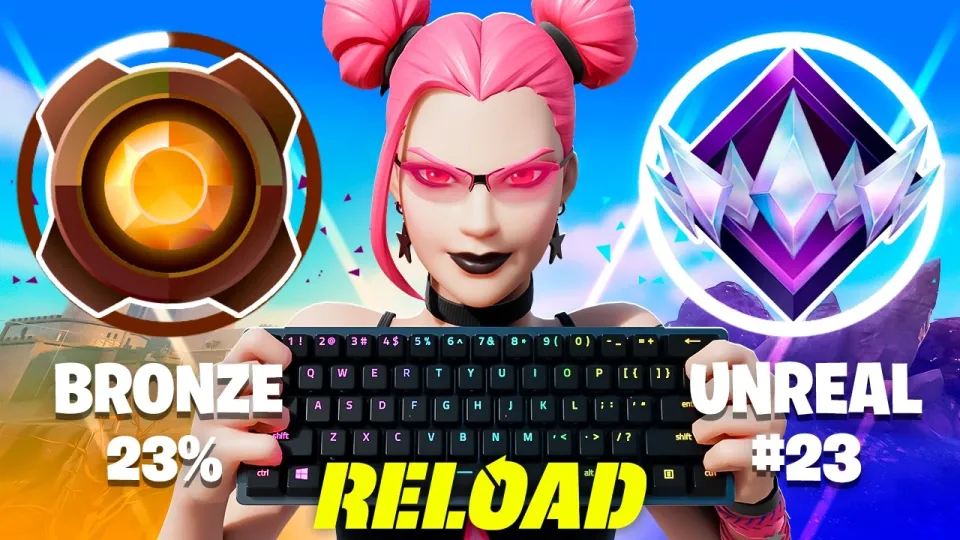
Video: BRONZE To UNREAL Ranked Speedrun In Fortnite Reload!
You can order the same kind of articles for your own video to boost it on YouTube and Google. Just message the Telegram bot @sat_sit_bot. The bot writes and publishes the articles itself (with your YouTube video embedded) on popular topical websites (no ads). Free trial — 50 articles.
A Fortnite Bronze-to-Unreal speedrun is a ranked climb where a player starts at the lowest tier, Bronze, and pushes through Silver, Gold, Platinum, Diamond, Elite, Champion and finally Unreal in as few matches as possible. In Fortnite Reload, that climb is faster than in standard Battle Royale because matches are shorter and respawns keep you in the fight, so total time depends on consistent placement points and elimination bonuses rather than one long survival run. HaloBT's run starts from Bronze and treats each bracket as a checkpoint, with practice maps like the ones listed at HaloBT's Fortnite creator page used for warm-ups before queueing.
What Fortnite Reload changes about a ranked climb
Fortnite Reload is a respawn-based mode played on a condensed map of classic locations, and that structure changes how rank points accumulate. Because you can re-drop after elimination while your team is still alive, a single bad fight does not end the match, so the cost of an aggressive push is lower than in build-mode Battle Royale. The trade-off is that fights chain together: wiping one squad often pulls in a second or third, which is exactly where most rank gains are lost in the middle brackets.
Ranked progression in Fortnite is driven by two numbers per match: placement and eliminations. Reload shortens the time between those two payouts, so a player who consistently reaches the top five while logging a handful of kills climbs faster than someone who hides to a high placement with zero damage. That is why a Bronze-to-Unreal attempt in Reload is measured in hours of queue time, not weeks of grinding.
The bracket-by-bracket reality of a Bronze to Unreal push
Each rank bracket in Fortnite behaves differently, and a speedrun has to plan around those differences rather than play one style from start to finish.
- Bronze and Silver: lobbies are forgiving, so the fastest route is direct aggression — land hot, take every fight, and convert early kills into placement points. Passive play here wastes time because the point ceiling per match is low.
- Gold: the first real filter. Players start holding angles and third-partying, so the speedrun needs cleaner rotations and a fixed drop plan instead of random contesting.
- Platinum and Diamond: mechanical consistency matters more than aggression. Editing speed, box fights and reset habits decide whether a fight ends in three seconds or thirty.
- Elite and Champion: lobbies are small and stacked, so placement points carry more weight; a top-five finish with modest eliminations is often worth more than a risky 12-kill game that ends in 20th.
- Unreal: the target tier, reached by accumulating enough points at the top of Champion. There is no fixed match count — the threshold moves with the season's point curve.
Solo queues, fills and the teammate problem
Running the climb solo in fills means every match starts with random teammates, and that randomness is the biggest variable in a speedrun. A coordinated trio can chain fights and share information; a fills squad often splits on drop or over-commits to a losing fight, which drags placement down even when your individual stats are strong.
The practical fix is to treat fills as a solo mode with optional support: pick your own landing spot, use teammates as distraction rather than as a plan, and rotate early enough that you are never the squad caught between two others. When a fills team does click, the same match becomes a fast point multiplier — that variance is why speedrunners restart queues quickly instead of trying to salvage bad lobbies.
Mechanics that decide the climb: aim, edits and 3D resolution
Rank gains in Reload are gated by fight speed, and fight speed is built from three habits: crosshair placement before the peek, edit resets under pressure, and consistent sensitivity across sessions. A warm-up map is the cheapest way to lock those in — HaloBT's own mechanics training map (search "halobt" in the Fortnite map browser) is built around aim, edit and piece-control drills, and the creator page at https://www.fortnite.com/@MoreHaloBT lists the current codes.
A recurring question from viewers is what to change when improvement stalls after switching input devices. The honest answer is that plateaus are usually decision plateaus, not aim plateaus: review where you die (bad rotation, over-peek, no cover) rather than only how you aim. Lowering 3D resolution is a popular challenge gimmick and a real performance lever on weaker hardware, but it does not fix positioning.
Common questions from players chasing Unreal
The most frequent doubts around a Bronze-to-Unreal run are about time, rank inflation and whether the mode matters. Time is the easy one: match count varies by bracket and by how many points per match you average, so a run with consistent top-five finishes and three to five eliminations will always beat a run with occasional 15-kill wins and frequent early exits.
On rank inflation, the concern is that Unreal is easier to reach than it used to be. That is partly true — the tier is a points threshold, not a fixed population — but the skill gap inside Unreal is wide, and a player who climbed through Reload respawns may still struggle in standard Battle Royale where a single death ends the match. Treat the climb as a mechanics and decision-making test, not as a badge.
Useful links
- HaloBT's Fortnite creator page with maps and updates: https://www.fortnite.com/@MoreHaloBT
- Community Discord for queues and questions: https://discord.com/invite/halobt
- Live streams: https://www.twitch.tv/halobt
- Updates on X: https://twitter.com/halobombtrooper
- Instagram: https://www.instagram.com/therealhalobt
What the run proves about ranked Fortnite
A Bronze-to-Unreal speedrun in Fortnite Reload is less about raw aim than about converting every match into two payouts: placement and eliminations. The brackets that stop most players are Gold and Platinum, where opponents start punishing slow rotations, and the brackets that reward patience are Elite and Champion, where a top-five finish outweighs a risky highlight reel. HaloBT's run is a useful template because it shows the climb as a sequence of adjustable habits rather than one long grind, and the practice maps linked from HaloBT's creator page are the fastest way to copy the warm-up routine. If you want the same structure in your own queues, start there, then review one death per session instead of chasing a new sensitivity every week.
Key takeaways
- HaloBT's run starts at Bronze and targets Unreal in Fortnite Reload, the faster-paced respawn mode built on classic POIs.
- Reload matches are shorter than standard Battle Royale, so rank progress depends on placement points plus elimination points per match.
- Climbing out of Gold and Platinum is the usual bottleneck: brackets tighten and third parties punish slow rotations.
- The run is played solo in fills-style queues, meaning random teammates and no pre-made squad coordination.
- Practice maps, including HaloBT's aim/edit piece, are used to warm up mechanics before ranked queues.
Source: BRONZE To UNREAL Ranked Speedrun In Fortnite Reload! · Markdown version
Questions & answers
How long does a Bronze to Unreal speedrun take in Fortnite Reload?
There is no fixed match count, because rank points depend on placement and eliminations per match. Reload matches are shorter than standard Battle Royale, so a player averaging a top-five finish with a few kills per game will climb noticeably faster than one chasing occasional high-kill wins. Expect the run to be measured in hours of queue time rather than a set number of games.
Is it better to play solo or in fills for a ranked climb?
Fills adds randomness: random teammates may split on drop or take losing fights, which hurts placement points. Playing fills as a solo — choosing your own landing spot, rotating early and using teammates as distraction — keeps your points stable while still allowing the occasional fast match when a squad clicks.
Why does Gold feel harder than Bronze and Silver?
Gold is where opponents start holding angles and third-partying consistently, so raw aggression stops paying. A fixed drop plan, cleaner rotations and faster fight resets matter more than landing hot every game.
What should I practice if my improvement has stalled?
Focus on decisions before aim: review where you die and whether it was a bad rotation, an over-peek or missing cover. Warm-up drills in a mechanics map — aim, edits and piece control — help maintain consistency, but they will not fix positioning errors on their own.